
How to Search Civil Dockets
The search begins on the Ascension Parish Clerk e-services page. From there, use the eClerks LA route and pick Ascension under Parish Search. Help material on eClerks separates Ascension land records from the Ascension marriage, civil, and criminal records destination. Choose the civil path for a suit docket. Access may run on subscription or day terms. Images and certified copies follow separate clerk procedures. Bring an Ascension suit number if you have one. It is the strongest identifier. Without it, work from the full caption, party role, approximate year, and Ascension court or division. A missing online image can mean the item is indexed but not released. It can also be historical, restricted, or only available through the Ascension clerk. The Civil Department and its public-access computers serve as the local fallback.
- Open the clerk's e-services route and select Ascension Parish in eClerks LA.
- Choose the marriage, civil, and criminal records destination rather than the land-record route.
- Search first with the suit number, then confirm the caption, division, filing date, and party roles.
- Read filings, service, motions, settings, orders, costs, and appeal entries in date order.
- Ask the Civil Department for the signed document, public terminal route, copy type, or certification needed.
Ascension Civil Department Workflow
Civil work at the Ascension Parish courthouse runs through the Ascension Civil Department. That office handles civil suits, adoptions, successions, and appeals. It also indexes filings, stamps their dates, and issues process. The office keeps the docket current, tracks court costs, and manages exhibits. Because of that mix, an Ascension civil docket blends true court actions with clerk-managed entries on filing, service, and costs.
The split matters when you search. An online index entry can point you to a filing. It can also point to an event in the case. Getting the actual petition, a signed order, a judgment, an exhibit, or a certified copy is another step. That record layer may take a trip to the Ascension clerk's public counter. An image purchase or a formal request may work too.
For the full picture, the official Civil Department page lays out how this Ascension office indexes the civil docket. It also explains how the office maintains those records.
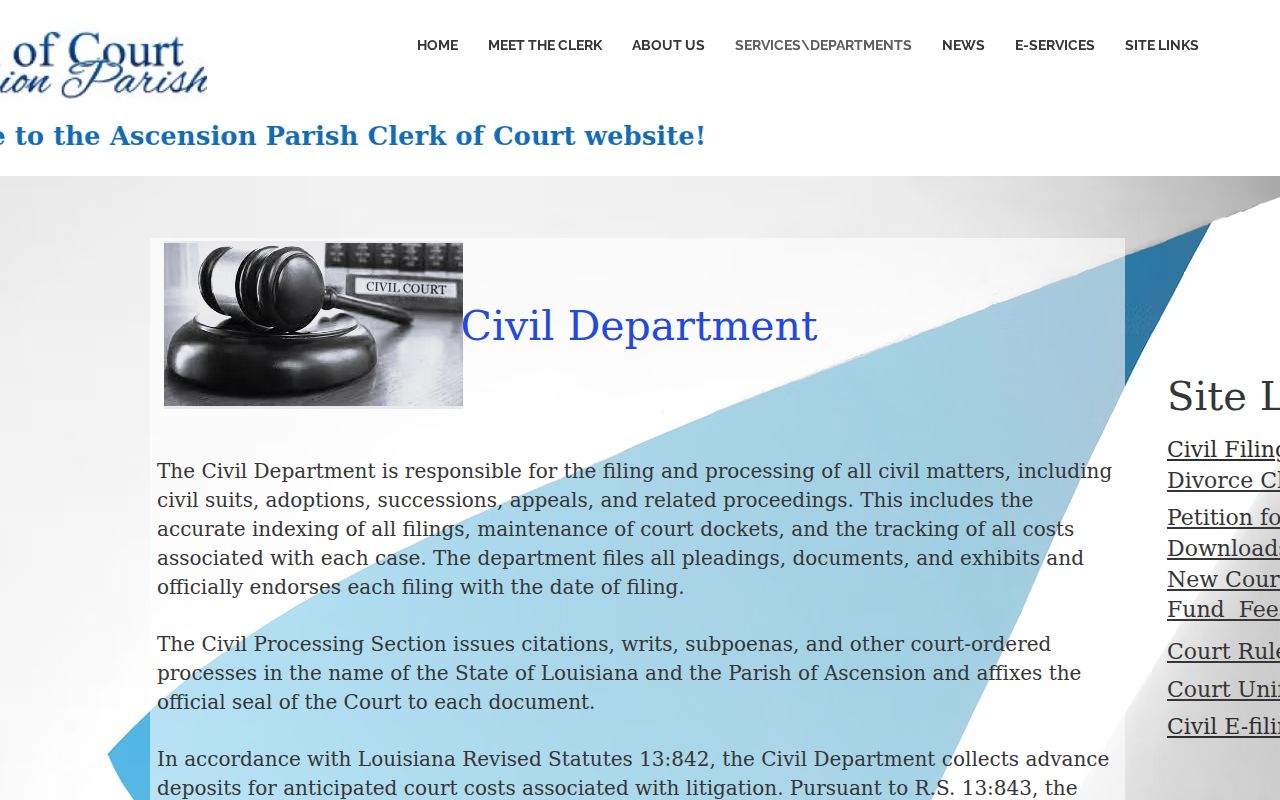
The department view ties an Ascension Parish civil docket search to the records the clerk keeps. Think filings, process, exhibits, and court costs.
What a Civil Docket Shows
Start by writing down the basics of the Ascension civil case. Grab the suit number, the Ascension court division, the judge or hearing officer, the caption, each party's role, the filing date, and the document that opened the file.
Then track what follows. Service status comes first. After that, watch for answers or reconventional demands, interventions, motions, rules, exceptions, discovery, exhibits, and hearing settings. Orders and judgments carry the rulings, and a notice of judgment, advance deposits, dismissal, or an appeal can come later. Certification or document-image status tells you what the record copy actually proves.
| Suit number and caption | The clerk-assigned identifier, case style, and party roles used to distinguish the civil case. |
|---|---|
| Division and filing date | The allotted court route and the date the clerk accepted the initiating document. |
| Service and response | Process issued or returned, an answer, reconventional demand, intervention, or other response event. |
| Motion or setting | A request, rule, exception, hearing, or trial date. A filed motion is not itself a ruling. |
| Order and judgment | The docket event that identifies a court action; read the signed document for its legal text. |
| Costs and appeal | Advance-deposit, copy, service, notice-of-judgment, dismissal, or First Circuit appeal activity. |
Late entries can change what a reader needs from the file. An Ascension case may hold a substantive judgment and still show later cost, satisfaction, amended-judgment, or appeal activity. None of that wipes out the earlier chronology.
Ascension Civil Filing Terms
Every label on an Ascension civil docket does something different. A petition opens the claim. Entries about service issued or returned only track the paperwork, not the result. Motions are simply requests. The judgment or order is the entry that records what the Ascension court actually did. Reading the terms in order helps you tell a filing event from a ruling.
- Advance deposit
- Money held for expected litigation costs, reflected in the clerk's cost tracking.
- Reconventional demand
- A claim asserted in the existing suit rather than a separate new suit number.
- Nonsuit
- A plaintiff's withdrawal of a demand under the applicable procedure; check the judgment text.
- Default judgment
- A civil judgment that may follow a failure to respond or appear when procedure allows.
- Notice of judgment
- An entry connected to notice of a court ruling and possible appeal timing.
A docket line that reads judgment is just a pointer. The signed judgment packet is what controls. Once you have the suit number and filing date, the Ascension clerk can name the exact document title and explain how to get a copy.
Types of Civil Cases on the Docket
Civil suits, adoptions, successions, and appeals all sit in the Ascension Civil Department's materials. The docket entries change with the type of case. A typical Ascension civil docket can list petitions, answers, service, motions, exceptions, discovery, exhibits, depositions, judgments, dismissals, and costs. Each event traces how the case moved.
- Ordinary civil suits and related petitions, answers, motions, and judgments.
- Successions and probate matters maintained through the Civil Department.
- Adoption and family-related proceedings subject to the applicable public-access limits.
- Executory process, garnishment, sequestration, or injunctive-relief filings with distinct deposit categories.
- Justice of the Peace appeals and trial-court appeals routed through the clerk.
The case type on an Ascension civil docket is a roadmap, not a verdict. It points you to the right division, the service path, the deposit category, and the documents you will need. For the actual outcome, you still have to read the Ascension docket itself along with the signed record.
Ascension Division F Family Dockets
Divorce, custody, support, paternity, adoption, and protective-order cases filed in Ascension Parish after December 31, 2024 now go to Division F. A 2025 local rule designates it the Twenty-Third JDC Family Court Division. Family cases that predate the change stay in divisions A through E. A transfer can move them.
Keep the date in mind during a family docket search. If the allotted division looks odd, the answer is usually routing, not the outcome. The rule says nothing about the parties or how the court will rule. Some family filings also carry access limits. That can hold even when a case number or a generic event shows up on the Ascension docket.
Settings and Hearings on Civil Dockets
When checking an Ascension civil date, trust the newest setting tied to the case itself. Pair it with the division or judge, the type of motion or trial, and the courthouse location. A hearing, rule, exception, or motion on an Ascension docket is just a procedural event. A filed motion is a request, not a grant. A general schedule never overrides the latest docket setting.
Sessions of Ascension Parish Court may sit in Gonzales, Donaldsonville, or Sorrento. A Twenty-Third JDC civil case, by contrast, has an allotted division. It also has its own clerk route. If a posted schedule and the civil docket disagree, keep the newer docket information. Confirm with the Ascension court or Civil Department before relying on the older schedule.
Ascension Civil Court Limits
Ascension Parish has two courts that hear civil cases, and the split matters. The Ascension Twenty-Third JDC is the general-jurisdiction court for civil matters of any size. Ascension Parish Court hears civil cases too. But only within the statutory $20,000 limit and outside its listed exclusions. No juries sit there. So a civil case on a Parish Court docket is not automatic. It is not automatically a district-court general civil suit.
| Route | Local civil role | Docket check |
|---|---|---|
| Twenty-Third JDC | General-jurisdiction civil and family matters, with divisions A through F | Ascension Clerk Civil Department and eClerks civil path |
| Ascension Parish Court | Parish-wide lower civil jurisdiction within its statutory limits | Parish Court rules, schedule, and court contacts |
| Justice of the Peace | Separate local court records and statutory duties | The particular JP court, then the clerk if an appeal is filed |
Know which court holds the file before you pay for a copy or request a hearing date. The court level determines where the docket lives, and it can change how the clerk handles an appeal or a certified record.
Ascension Civil Filing Costs
Filing a civil suit in Ascension starts with an advance deposit, and the amounts vary. The current fee schedule lists $355 without service. It lists $405 with one service, and $435 when the clerk holds service until a court date is set. Adoption and name change cases carry their own deposit amounts. So do Justice of the Peace appeals, executory process, sequestration or injunctive relief, garnishment, and extra service. Treat these as categories, not a final bill for every case.
Beyond the deposit, the same schedule lists a $150 courthouse building charge on an initial civil filing, adoption excluded. It adds $30 for each additional pleading. The clerk states that these charges are rolled into the advance deposit. Later work such as service, exhibits, or copies can still shift the total cost.
The Ascension civil filing-fee page shows the current deposit categories. It also shows certification and minute fees, and the clerk's own filing notices.
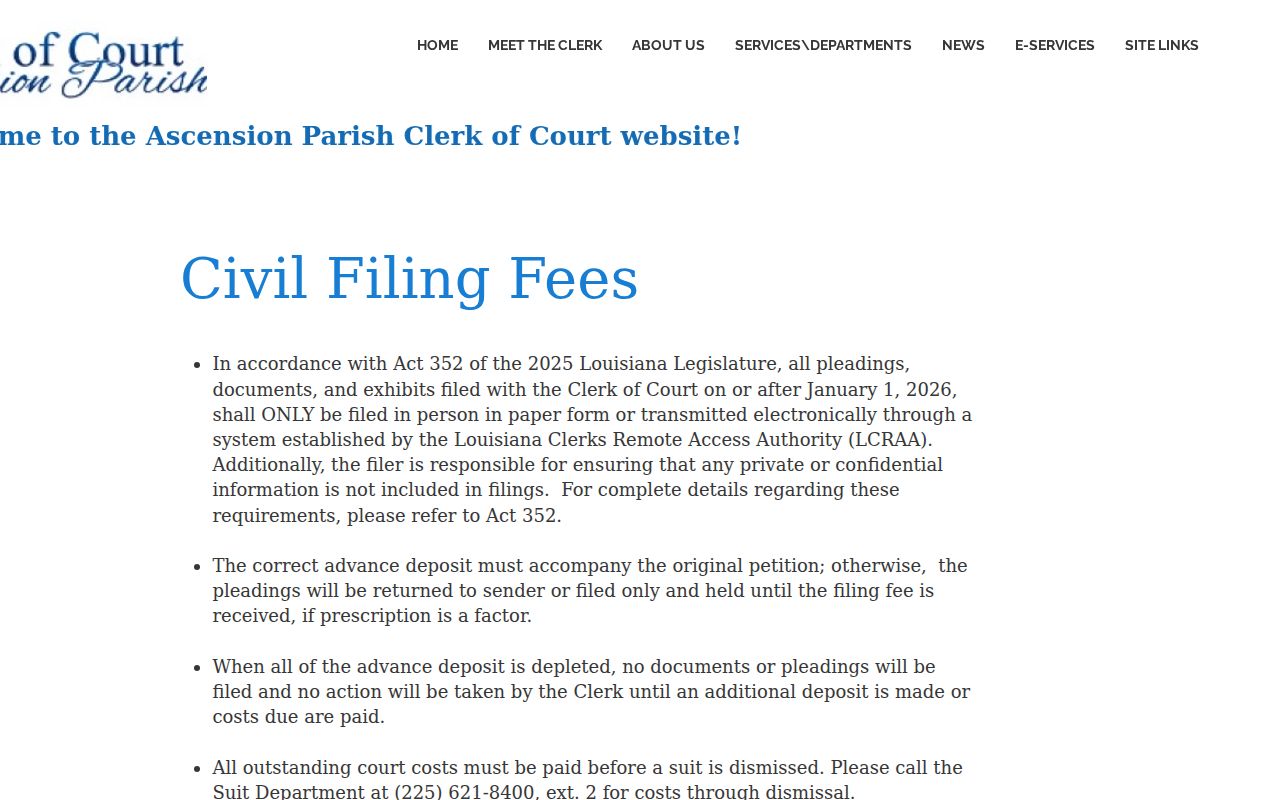
The fee schedule does more than set prices. It helps you tell apart an advance deposit, a plain copy, and a certified judgment request in an Ascension civil file.
Public Access to Civil Dockets
Open Ascension civil dockets reach the public in a few ways. eClerks, the clerk's public computers, and Civil Department records procedures are the main routes. Louisiana law backs the right to inspect and copy public records, with lawful exceptions. One caution: a docket event, a document image, a plain copy, a conformed copy, and a certified copy are different products. Each can carry its own access rule and fee path in Ascension. Know which product you need before you ask.
Key rules for Ascension civil dockets:
Louisiana R.S. 44:1 defines public records broadly, including electronic information and databases used in public business.
Louisiana R.S. 44:31 makes access a custodian duty unless an exception applies.
Louisiana R.S. 44:32 addresses inspection during regular hours and reasonable copy or transmission fees.
Sealed Ascension civil records sit under local court rules. No one may view, withdraw, or unseal them without the required written court order. A sealed or restricted label marks access status only; it says nothing about the merits of the case.
Ascension Certified Civil Judgments
Ordering a copy from the Ascension Civil Department works best with specifics. Give the suit number, caption, document title, filing date or docket line. Then state the format you want: plain, conformed, certified, minute entry, or document image. Ask two more questions. Is the item imaged and released online, or is a counter copy the only option? Which fee schedule covers that department and record type?
The numbers differ by format. The current civil schedule lists $5 for a certified copy. It lists $3 for a conformed copy, $1 for a plain copy, and $5 for a minute entry in the without-service category. An older August 2017 recording schedule carries different figures for recording-department work. Confirm which Ascension schedule applies before treating a recording fee as the civil-court copy fee.
One final warning comes from the clerk's current information. Outstanding costs must be paid before dismissal and before any certified judgment copy. A docket line reading judgment is not the same as a final certified judgment packet.
Ascension Civil Filing Context
How busy is the Ascension civil docket? The Louisiana Supreme Court's 2024 annual report lists 4,152 civil filings for Ascension in the Twenty-Third JDC district row. That row shows 5,855 total filings across civil, criminal, and juvenile categories. The court system cautions that traffic, misdemeanor, juvenile, and family matters may be reported through parish, city, juvenile, or family courts instead. So the figure is not an all-court parish total.
The official annual report supplies that reporting context. It is a good reason to pin down the court and record type before making any Ascension civil docket request.
Ascension Civil Electronic Records
Ascension's electronic records rest on two legal pillars. Louisiana R.S. 13:754 created the Louisiana Clerks' Remote Access Authority. It directs Ascension district clerks to support electronic filing, recording, and remote access through LCRAA. Current Code of Civil Procedure article 253 governs Ascension electronic filing and storage. It also covers filer redaction duty, filing confirmation, and the official electronic record where electronic filing is accepted.
Local practice follows the statute. Ascension's filing procedures and clerk e-services name LCRAA and eClerks LA. Both are part of the local route for filing and storage. An electronic record can be official while staying out of public view. Redaction, sealing, release status, and the clerk's copy procedures still decide what a public search returns. Each one can hide or reveal a record.
One last point: electronic access can locate a civil record. Certification and any restricted-document procedure stay with the clerk.
Ascension Civil Counter Routing
Not every Ascension civil docket has a remote image. When the case is historical, call ahead. The same goes for unclear document types. If nothing appears online, use the clerk's public computers. Civil-suit questions route through extension 2. An Ascension Donaldsonville satellite route runs through extension 8. Before you go, gather the suit number, caption, approximate year, Ascension court or division, document title, and the copy type you need.
The Ascension Clerk contact page gives the department routing. It also covers office routing for civil suits and the Donaldsonville office.
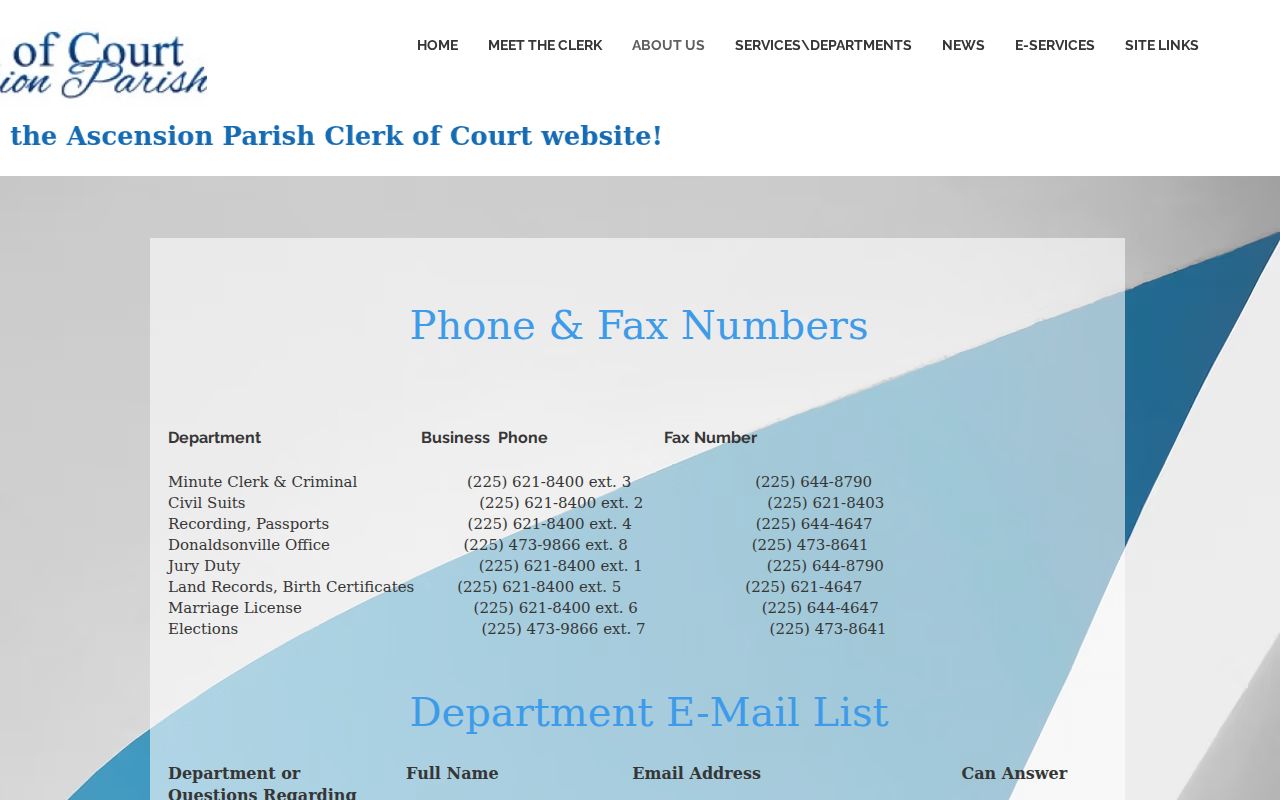
A call-first approach saves trips. It works well whenever an Ascension civil docket needs a clerk-held record or a precise copy request.