
How to Search Criminal Dockets
Most Ascension Parish criminal docket lookups run through the Ascension Parish Clerk e-services page and its eClerks LA application. Pick Ascension in Parish Search. Then choose the marriage, civil, and criminal records option, not land records. The clerk bills eClerks as a remote-access service. Even so, the public system may ask for a subscription, day access, or a document purchase before some material opens up.
The clerk-assigned Ascension case number is the best starting identifier. A full caption helps too. Add the approximate filing year, the Ascension court or division, the charge type, and the issuing agency. Even a common name narrows fast. The public materials promise no wildcard rules or one universal live search form. So a missing name result means you should try stronger identifiers. Or call the Ascension Criminal/Minute Clerk. It does not mean no court case exists.
- Open the clerk's e-services route and choose Ascension in eClerks Parish Search.
- Select the civil and criminal case-management destination, then use the most specific case identifier available.
- Confirm the court, division, caption, filing date, and latest minute or docket event before relying on the match.
- Read the charge, arraignment, settings, motions, and disposition in chronological order.
- Use the clerk's terminal or records route for a signed judgment, a certified copy, an unreleased image, or a historical file.
Ascension Criminal Minute Clerks
Ascension's Criminal/Minute Clerk Department is where the formal work happens. The office files charges brought by the district attorney. It also keeps felony and misdemeanor matters, criminal minutes, notices, subpoenas, warrants, expungements, and related proceedings. The court case record lives here. Police agencies hold incident, booking, arrest, or citation-payment records. It is not the home of the docket itself.
A minute clerk sits in the courtroom. The clerk records each official Ascension court event. The clerk may also issue notices, administer oaths, and file admitted exhibits. A minute may show a plea or ruling. What it cannot do is replace the signed judgment, sentencing document, charge instrument, or exhibit. You need the clerk for the underlying Ascension document itself. The department's official description names the office that maintains these Ascension criminal docket materials.
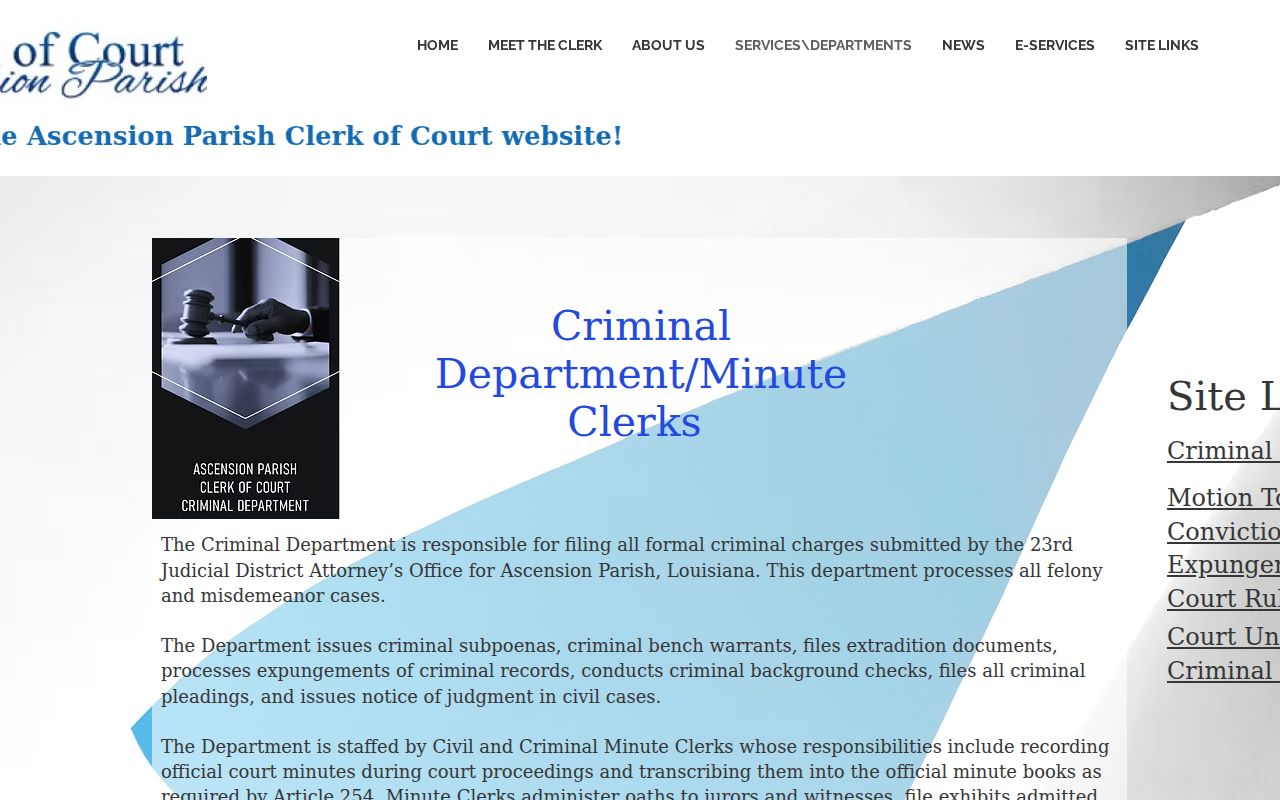
The clerk-office view draws the same line again. A criminal minute entry is one slice of the larger public case file sitting behind it.
What a Criminal Docket Shows
Think of an Ascension criminal docket as a time-ordered case history. Read the header first. The fields that anchor a search are the Ascension court and division, case number, caption, filing date, charge or count, charging instrument, and the latest setting. Later lines tell the story of the case. They can flag counsel activity, motions, notices, minute entries, disposition, sentence, payment or probation events, a warrant event, appeal, expungement indicator, and any public document link that comes with the file.
| Case number and court | The clerk-assigned identifier and the Twenty-Third Judicial District Court or Ascension Parish Court route. |
|---|---|
| Charge and filing | The charging line, count, statute or charge code, and the instrument used to begin the court matter. |
| Minute entry | The official event record, such as arraignment, ruling, notice, reset, plea, or sentence event. |
| Setting | The scheduled appearance, including its date, event type, and division or court information. |
| Judgment or document | A docket link may identify a document, but the signed judgment or certified copy comes from the clerk. |
Read each later Ascension entry against the earlier one it changes. A new setting can wipe out an old date. Shorthand in an Ascension minute line matters less than a later signed order.
Ascension Criminal Minute Entries
Louisiana R.S. 13:5992 requires electronic public access through LCRAA to criminal minute entries or summaries. The statute covers qualifying district-court cases filed on or after January 1, 2020. But the statute has a limit. It does not put every pleading, exhibit, transcript, or image into that electronic result.
The Ascension clerk's Online ACCESS disclaimer adds another limit. A released result has been indexed, verified, and released for public viewing. The online index is not the official public record. A record bearing an official number may still be waiting for indexing. So treat the Ascension minute as an event trail. Then ask the clerk for the record layer you actually need.
- Minute entry
- The court's recorded event or minutes, maintained by the minute clerk.
- Released or indexed
- An Online ACCESS status for public viewing, not a statement that the record is certified or complete.
- Disposition
- The recorded outcome. Confirm its exact wording in the judgment or minute.
- Expungement
- A separate statutory or court process handled through the Criminal Department, not an ordinary search filter.
Stages on a Criminal Docket
An Ascension criminal docket usually walks a familiar path. It begins with a charge or charging instrument. From there it moves through custody and bail activity, then arraignment, pretrial motions or hearings, a plea or trial setting, disposition, and sentencing. The order matters. An attorney appearance or a motion is only a request or procedural event. A ruling or signed order is what reflects the Ascension court's action.
Docket flow: Filing › Arraignment › Pretrial › Plea or Trial › Disposition › Sentencing
A continuation or reset just sends the Ascension case to a new setting. It resolves nothing. Probation, payment, appeal, warrant, or expungement activity can appear long after disposition, so do not mistake those later lines for the outcome itself.
Ascension 72-Hour Criminal Settings
The 23rd JDC local-rule appendix describes 72-hour hearings, initial bail settings, pretrial motions and hearings, arraignments, and certain audio-video appearance categories. These labels mark a stage or a setting type. They do not tell you a case ended. Nor do they say a remote appearance is open to every party.
Arraignment is the formal charge-and-plea stage in Ascension. A pretrial label signals litigation before trial. And an Ascension trial setting is a scheduled proceeding, not proof a trial happened. For any single Ascension criminal docket, follow the specific minute, notice, and court instruction.
Ascension Criminal Court Split
The Twenty-Third Judicial District Court is Ascension's general-jurisdiction trial court. The clerk's Criminal Department handles felony and misdemeanor cases filed there. Ascension Parish Court, meanwhile, takes lower-level state, parish, and municipal violations within its statutory limits. It posts traffic and criminal session categories. Justice of the Peace and municipal routes sit outside that system as separate local records.
| Court route | Criminal docket focus | Where to confirm |
|---|---|---|
| Twenty-Third JDC | General-jurisdiction criminal cases, including felony proceedings | Ascension Clerk criminal case-management route and Criminal/Minute Clerk |
| Ascension Parish Court | Lower-level violations and published criminal or traffic sessions | Parish Court rules, schedule, and court staff |
| JP or local municipal process | Local statutory matters or ordinance routes | The particular court or issuing agency |
The court name on an Ascension filing is a routing fact, nothing more. An Ascension traffic payment page or an agency arrest number can help, but neither is automatically the clerk's court case number.
Ascension Criminal Setting Labels
Ascension Parish Court calendars carry labels. Think Arraignments, Prisoners, Impositions, Trials, Traffic Criminal, Juvenile Traffic, and Juvenile/DCFS. Agency and location tags such as APSO, GPD, LSP, Donaldsonville, and Gonzales appear there too. These route a case to a place or an office. They are not disposition codes. They never signal a finding of guilt.
An Impositions session in Ascension might deal with fines, costs, or a disposition setting. The exact result lives in the case-specific minute or judgment. Juvenile Traffic and Juvenile/DCFS carry their own confidentiality boundary. Before reading anything into a schedule label, check the docket's court. Then check the case number and most recent minute.
Which Court Holds Criminal Dockets
The Twenty-Third Judicial District Court serves three parishes. It covers Ascension, Assumption, and St. James. Ascension has divisions A through F and hearing officers. Clerk of Court Bridget Hanna is the central records office. For a district criminal case, her office keeps the Ascension case docket. Public terminals in Gonzales and Donaldsonville are the local fallback.
Ascension Parish Court serves a different function. Its schedule and local rules can flag a lower-level criminal or traffic session. The clerk-held case docket and the court's own staff still determine the individual matter. The state Attorney General directory identifies three separate Ascension Justice of the Peace courts. Confirm those Ascension records with the JP court directly.
Ascension Criminal Warrant Events
A bench warrant in Ascension is a court-process event, not a conviction. The same goes for a continued or reset minute. That entry moves the case date. It does not dismiss a charge, and an Ascension docket holds both case status and scheduling history.
Read the latest entry. A warrant, a reset, a plea, and a final judgment describe different events. Compare the date and event type, then obtain the signed document from the clerk when the legal effect matters.
Keep three things from a recent Ascension setting. They are the court case number, the charging or agency identifier, and the date of the latest minute. That trio is your safeguard. It keeps an agency record or a similar name from passing as the same Ascension criminal docket.
Ascension Juvenile Docket Limits
Ascension's ordinary public access stops at juvenile confidentiality. Louisiana Children's Code art. 412 makes juvenile records and reports confidential except for authorized disclosures. The Ascension Criminal Department marks juvenile delinquency and children-in-need-of-care material as protected. Access questions go through the lawful court-order route.
Sealed, restricted, or expunged marks an access condition. It does not mean the case was dismissed or never filed. Ask the Ascension clerk what public portion exists. A written request, statutory authority, or court order may be required. The clerk will say which. Never use the public index to work around a restriction.
Public Access and Sealed Criminal Dockets
Louisiana's Public Records Law backs public access to records kept in the course of public business. Ascension court records carry statutory and court-ordered exceptions. For an open Ascension criminal record, three routes exist. The electronic route, a public-access computer, or the Criminal/Minute Clerk all work. Fees differ by product. Inspection, a plain copy, a certified copy, a minute entry, and a document image follow different Ascension procedures and fees.
Key rules for Ascension criminal dockets:
Louisiana R.S. 44:31 makes inspection and copying a custodian duty unless a lawful exception applies.
Louisiana R.S. 44:32 provides for examination during regular hours and allows reasonable posted copy fees.
Louisiana R.S. 13:5992 addresses electronic access to qualifying criminal minute entries or summaries, not every underlying image.
Local district rules park sealed records in the clerk's repository. Getting at them takes a written court order. The online index is only a lead; the clerk's office remains the authoritative source for an official or certified record.
Ascension Criminal Counter Search
Online lookups let you down sometimes. When the Ascension remote portal reports no authority, returns only a common-name list, or shows no image at all, head to a clerk's public-access terminal in Gonzales or Donaldsonville. Come prepared: case number or full caption, the rough year, the Ascension court or division if you know it, and the record type. If your question concerns an Ascension hearing, bring the latest setting date too. Prefer the phone? Call the clerk's main line at 225-621-8400. Then route to the Criminal/Minute department through extension 3.
There is also the older route. The Online ACCESS sign-in route greets many visitors with an authority or sign-in notice instead of results. Its official disclaimer states plainly that online indexing is not the official public record. So when an online docket result looks thin or incomplete, do not stop there. A terminal search or a direct call to the clerk is the sensible move.
The legacy Ascension Online ACCESS page displays exactly that authority-based route. That route can push you toward a different access channel.
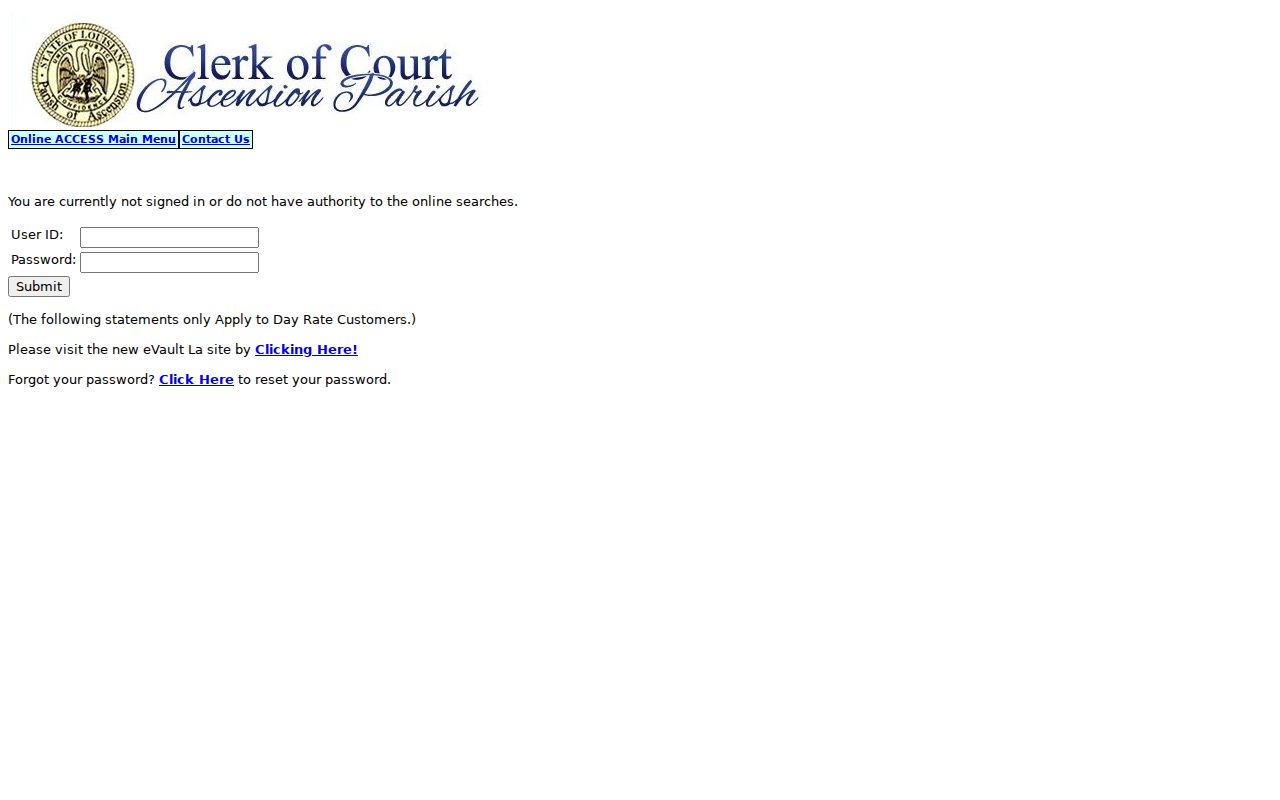
That sign-in state is why every Ascension criminal docket search keeps a public-terminal and clerk-contact fallback.
Ascension Criminal Filing Context
The Louisiana Supreme Court's 2024 annual report puts Ascension's criminal filings at 1,278 in the Twenty-Third JDC district table. The same row lists 5,855 total filings. Civil and juvenile categories sit inside that number. So this is not a parish-wide count. Louisiana's reporting structure can route Ascension traffic, misdemeanor, juvenile, and city-court matters to parish, city, juvenile, or family courts instead.
The official 2024 annual report supplies the court-system context. It also explains a practical rule. A criminal docket search starts by naming the correct court, because no single parishwide database holds every record. One caveat: the district-table figures describe a reporting row, not every criminal or traffic matter handled in Ascension Parish.